Kontent qismiga oʻtish

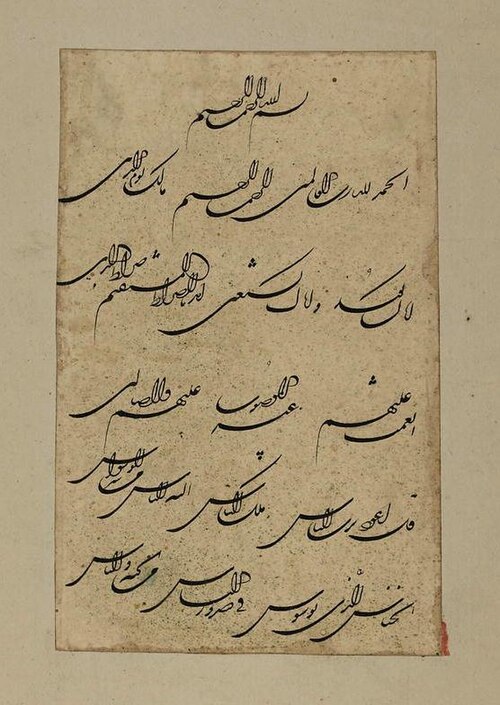
Fayl:Shikastah script.jpg

ZiyoSfera, erkin ensiklopediya
Asl fayl (556 × 784 piksel, fayl hajmi: 75 KB, MIME tipi: image/jpeg)

Ushbu fayl Vikiomborga yuklangan boʻlib, boshqa loyihalarda ham qoʻllanilishi mumkin. Uning tavsif sahifasidan olingan maʼlumot quyida keltirilgan.

Taʼrif
English: This calligraphic fragment is executed in fine shikastah (literally, "broken") script and includes an initial bismillah and chapters (surahs) 1 and 114 of the Qur'an. At the top appears the first chapter of the Qur'an, entitled al-Fatihah (The Opening).
These two short surahs from the Qur'an appear together here probably because they are short, easily memorized, and recited aloud. It is quite unusual, however, to find Qur'anic verses executed in shikastah, a very fluid script invented in Persia (Iran) by the 18th-century calligrapher Darvish 'Abd al-Majid al-Taliqani (Tavoosi 1987: 34-35). During the 18th and 19th centuries, Qur'ans were written in naskh or nasta'liq, as these scripts were more legible than shikastah. For this reason, this particular fragment stands out as scarce proof that some Qur'anic ayahs were executed in shikastah in Iran during the 18th-19th centuries.
Sanasi 18th-19th centuries
Manba
This calligraphic fragment is available from the United States Library of Congress's African & Middle Eastern division
under the digital ID ascs.102.
This tag does not indicate the copyright status of the attached work. A normal copyright tag is still required. See Commons:Licensing.

العربية ∙ беларуская (тарашкевіца) ∙ বাংলা ∙ čeština ∙ Deutsch ∙ English ∙ español ∙ فارسی ∙ suomi ∙ français ∙ galego ∙ עברית ∙ magyar ∙ Bahasa Indonesia ∙ Ido ∙ italiano ∙ 日本語 ∙ Bahaso Melayu Jambi ∙ lietuvių ∙ македонски ∙ മലയാളം ∙ Nederlands ∙ polski ∙ português ∙ português do Brasil ∙ română ∙ русский ∙ sicilianu ∙ slovenčina ∙ slovenščina ∙ Türkçe ∙ українська ∙ 中文 ∙ 中文(简体) ∙ 中文(繁體) ∙ +/−

Muallif Unknown calligrapher
Ruxsat
(Bu faylning takror foydalanilishi)
This is a faithful photographic reproduction of a two-dimensional, public domain work of art. The work of art itself is in the public domain for the following reason:
Public domain

This work is in the public domain in its country of origin and other countries and areas where the copyright term is the author's life plus 70 years or fewer.


You must also include a United States public domain tag to indicate why this work is in the public domain in the United States.
This file has been identified as being free of known restrictions under copyright law, including all related and neighboring rights.
The official position taken by the Wikimedia Foundation is that "faithful reproductions of two-dimensional public domain works of art are public domain".
This photographic reproduction is therefore also considered to be in the public domain in the United States. In other jurisdictions, re-use of this content may be restricted; see Reuse of PD-Art photographs for details.
{{PD-Art}} template without license parameter: please specify why the underlying work is public domain in both the source country and the United States
(Usage: {{PD-Art|1=|deathyear=''year of author's death''|country=''source country''}}, where parameter 1= can be PD-old-auto, PD-old-auto-expired, PD-old-auto-1996, PD-old-100 or similar. See Commons:Multi-license copyright tags for more information.)

Captions

Add a one-line explanation of what this file represents

Items portrayed in this file

tasvirlangan obyekt

data size inglizcha

76 350 Bayt

width inglizcha

556 piksel

image/jpeg

checksum inglizcha

ae21d1756c633ea51927617107401eef5de68ef2

Fayl tarixi

Faylning biror paytdagi holatini koʻrish uchun tegishli sana/vaqtga bosingiz.

Sana/VaqtMiniaturaOʻlchamlariFoydalanuvchiIzoh
joriy00:11, 2013-yil 12-avgust00:11, 2013-yil 12-avgust dagi versiya uchun tasvir556 × 784 (75 KB)wikimediacommons>Kiatddcropped

Bu faylga quyidagi sahifa bogʻlangan:

Metama’lumot