
Fayl:Pith ball electroscope operating principle.svg

Size of this PNG preview of this SVG file: 651 × 600 piksel. Boshqa oʻlchamlari: 2 223 × 2 048 piksel.
Asl fayl (SVG fayl, asl oʻlchamlari 1 065 × 981 piksel, fayl hajmi: 56 KB)

Qisqa izoh
| Taʼrif |
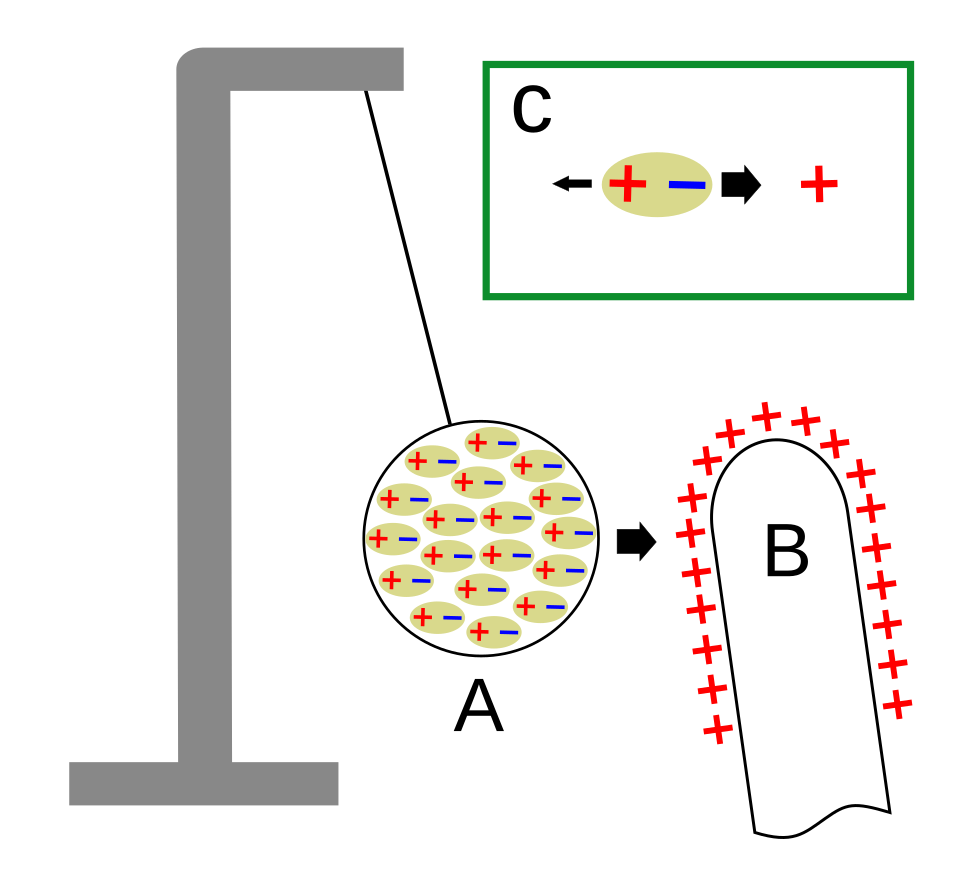
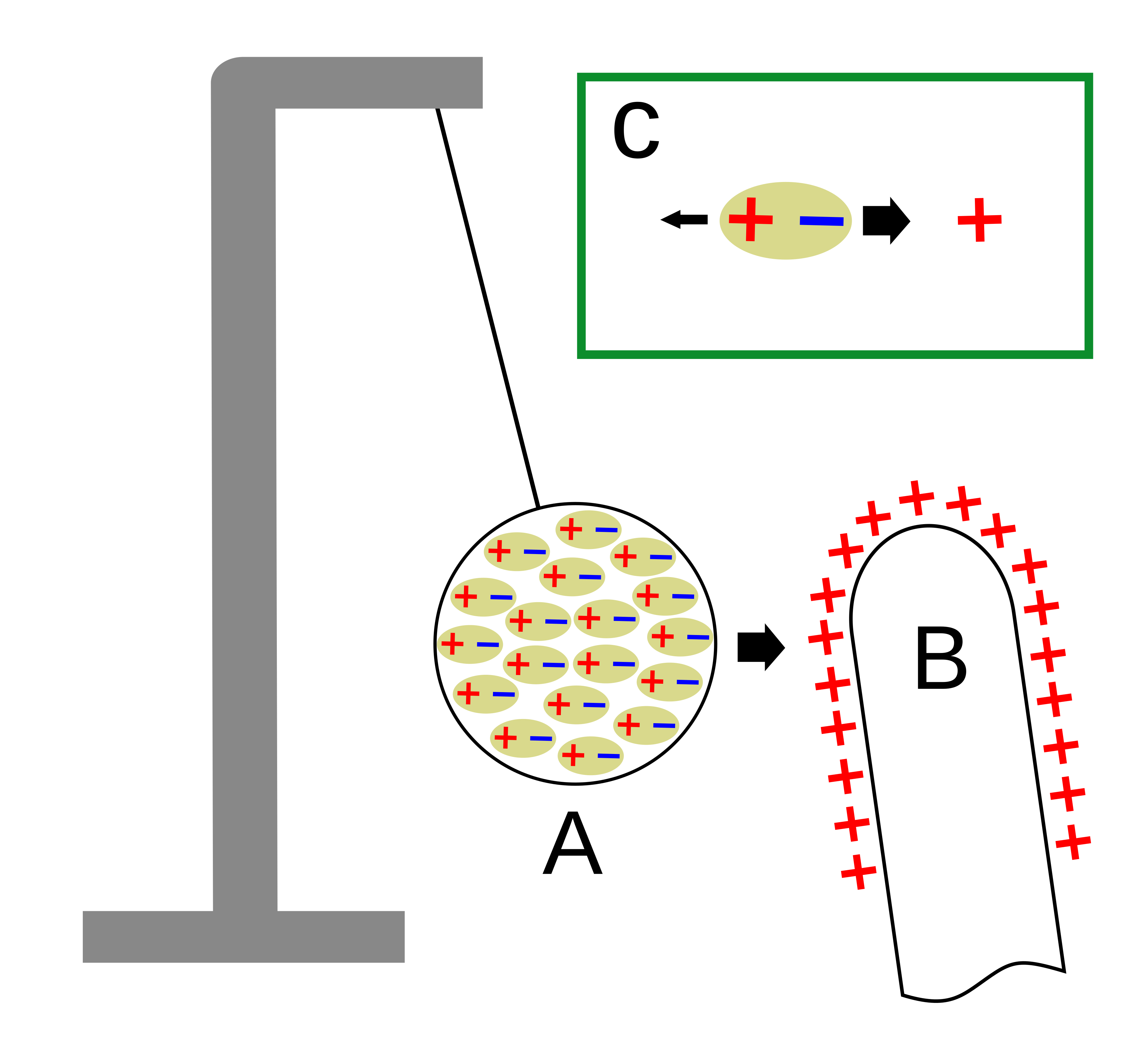
English: Diagram showing how a pith-ball electroscope works. The molecules (yellow ovals) that make up the pith ball (A) consist of positive charges (atomic nuclei) and negative charges (electrons) close together. Bringing a charged object (B) near the pith ball causes these charges to separate slightly. If the object has a positive charge, the electrons ( – ) in the molecules will be attracted to it, and will move to the side of the molecule near the object. The nuclei ( + ) will be repelled and will move to the side of the molecule away from it. This is called polarization. Since the electrons are now closer to the external charge than the nuclei (C) their attraction is stronger than the repulsion of the nuclei, and therefore the result is a weak attractive force. The separation of charges is microscopic, but since there are so many atoms in the pith ball the total force is strong enough to pull the pith ball toward the external charge. |
| Sanasi | |
| Manba | Oʻzimning ishim |
| Muallif | Chetvorno |
Litsenziyalash
I, the copyright holder of this work, hereby publish it under the following license:
 
|
This file is made available under the Creative Commons CC0 1.0 Universal Public Domain Dedication. |
| The person who associated a work with this deed has dedicated the work to the public domain by waiving all of their rights to the work worldwide under copyright law, including all related and neighboring rights, to the extent allowed by law. You can copy, modify, distribute and perform the work, even for commercial purposes, all without asking permission.
|
Fayl tarixi
Faylning biror paytdagi holatini koʻrish uchun tegishli sana/vaqtga bosingiz.
| Sana/Vaqt | Miniatura | Oʻlchamlari | Foydalanuvchi | Izoh | |
|---|---|---|---|---|---|
| joriy | 08:23, 2012-yil 3-oktyabr | | 1 065 × 981 (56 KB) | wikimediacommons>Chetvorno | User created page with UploadWizard |
Fayllarga ishoratlar
Bu faylga quyidagi sahifa bogʻlangan:
