
Fayl:PIA19061-SaturnMoonEnceladus-CurtainNotDiscrete-Eruptions-20150506.jpg


Qisqa izoh
| Taʼrif |
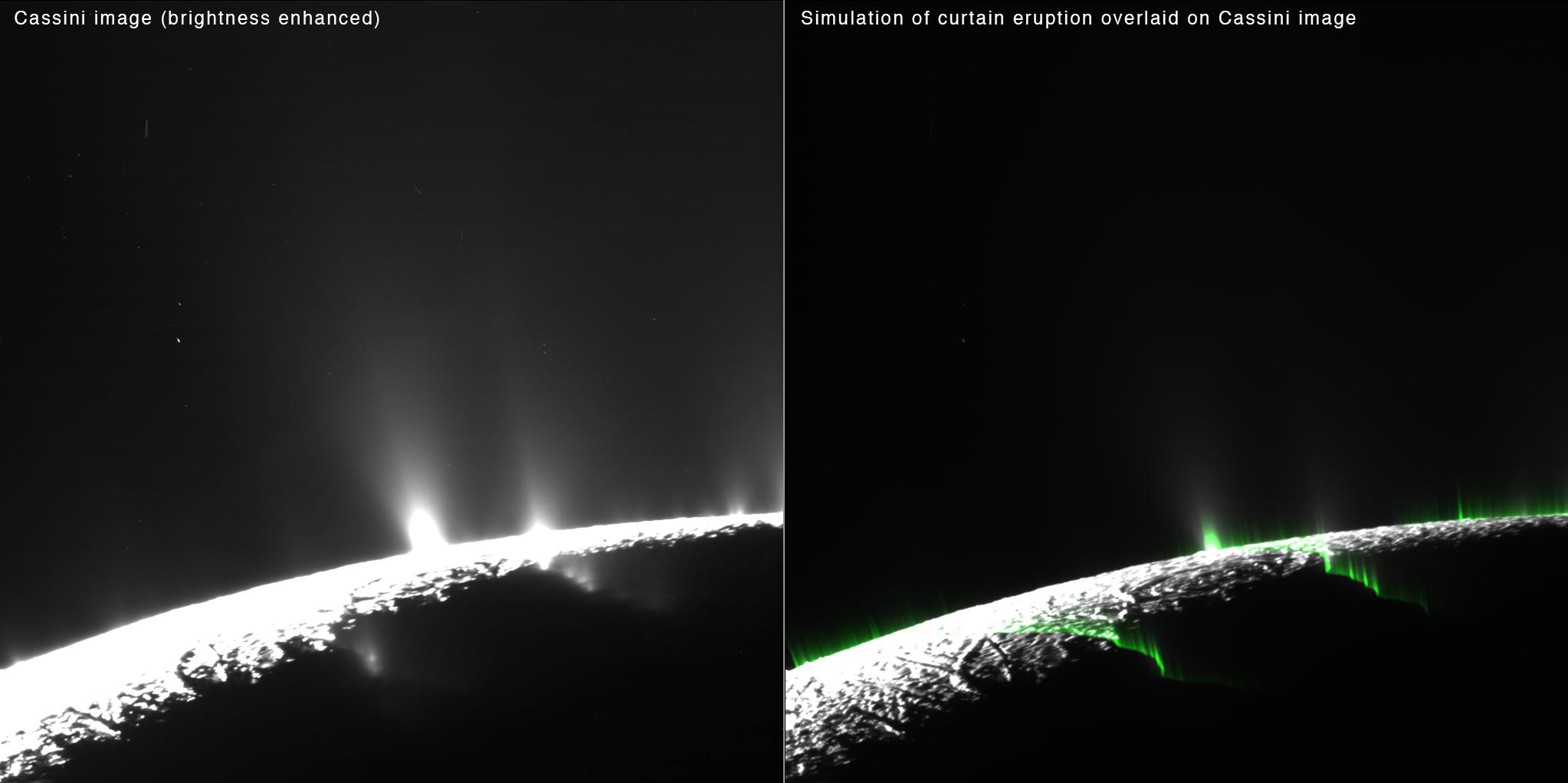
English: PIA19061: Enceladus Curtains: Comparing Data and Simulation
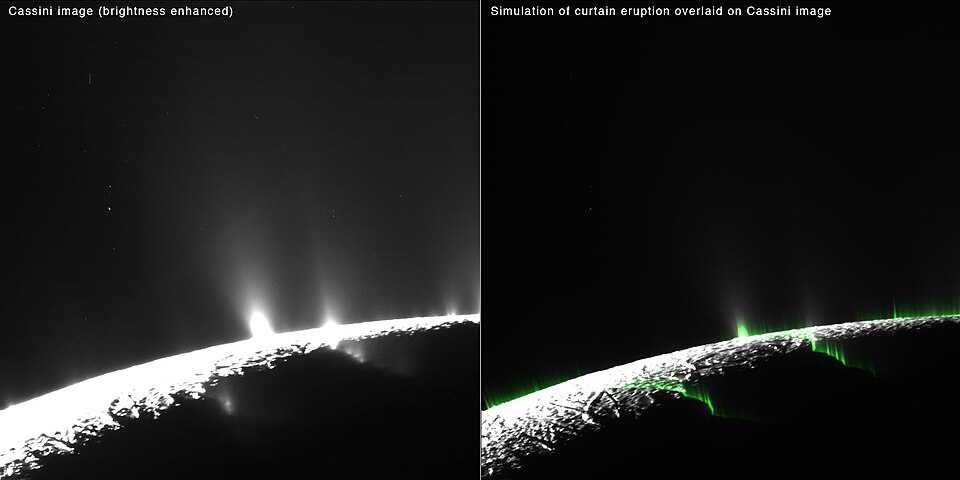
http://photojournal.jpl.nasa.gov/catalog/PIA19061 Phantom jets in simulated images produced by the scientists line up nicely with some of the features in real images from NASA's Cassini spacecraft that appear to be discrete columns of spray. Researchers modeled eruptions on Saturn's moon Enceladus as uniform curtains along prominent fractures that stretch across the icy moon's south pole. They found that brightness enhancements appear as optical illusions in places where the viewer is looking through a "fold" in the curtain. The folds exist because the fractures in Enceladus' surface are more wavy than perfectly straight. The researchers think this optical illusion is responsible for most -- but not all -- of what appear to be individual jets. Some discrete jets are still required to explain Cassini's observations. Phantom jets in simulated images produced by the scientists line up nicely with some of the features in real Cassini images that appear to be discrete columns of spray. The correspondence between simulation and spacecraft data suggests that much of the discrete-jet structure is an illusion. Curtain eruptions occur on Earth where molten rock, or magma, gushes out of a deep fracture. These eruptions, which often create spectacular curtains of fire, are seen in places like Hawaii, Iceland and the Galapagos Islands. See PIA19060 for a related image and video animation. The Cassini-Huygens mission is a cooperative project of NASA, the European Space Agency and the Italian Space Agency. NASA's Jet Propulsion Laboratory, a division of the California Institute of Technology in Pasadena, manages the mission for NASA's Science Mission Directorate, Washington. The Cassini orbiter and its two onboard cameras were designed, developed and assembled at JPL. The imaging operations center is based at the Space Science Institute in Boulder, Colo. For more information about the Cassini-Huygens mission visit http://saturn.jpl.nasa.gov and http://www.nasa.gov/cassini. The Cassini imaging team homepage is at http://ciclops.org. |
| Sanasi | |
| Manba | http://photojournal.jpl.nasa.gov/jpeg/PIA19061.jpg |
| Muallif | NASA/JPL-Caltech/SSI/PSI |
Litsenziyalash
  |
This media was created by the Jet Propulsion Laboratory (JPL) at Caltech. Their website states: "Unless otherwise noted, images and video on JPL public web sites (public sites ending with a jpl.nasa.gov address) may be used for any purpose without prior permission, subject to the special cases noted below. Publishers who wish to have authorization may print this page and retain it for their records; JPL does not issue image permissions on an image by image basis." Conditions:
By electing to download the material from this web site the user agrees:
Special Cases:
Usage on the English Wikipedia: On the English Wikipedia you can use the {{JPL Image}} template to display the copyright notice. (See Wikipedia:Using JPL images for details) |
Fayl tarixi
Faylning biror paytdagi holatini koʻrish uchun tegishli sana/vaqtga bosingiz.
| Sana/Vaqt | Miniatura | Oʻlchamlari | Foydalanuvchi | Izoh | |
|---|---|---|---|---|---|
| joriy | 02:28, 2015-yil 7-may | | 2 046 × 1 022 (86 KB) | wikimediacommons>Drbogdan | User created page with UploadWizard |
Fayllarga ishoratlar
Bu faylga quyidagi sahifa bogʻlangan:
