Kontent qismiga oʻtish

Fayl:PIA19059-SaturnMoon-Enceladus-OceanMethane-20150311.png

ZiyoSfera, erkin ensiklopediya
Asl fayl (4 820 × 3 906 piksel, fayl hajmi: 7,6 MB, MIME tipi: image/png)

Ushbu fayl Vikiomborga yuklangan boʻlib, boshqa loyihalarda ham qoʻllanilishi mumkin. Uning tavsif sahifasidan olingan maʼlumot quyida keltirilgan.

Qisqa izoh

Taʼrif
English: PIA19059: Trapping of Methane In Enceladus' Ocean

http://photojournal.jpl.nasa.gov/catalog/PIA19059

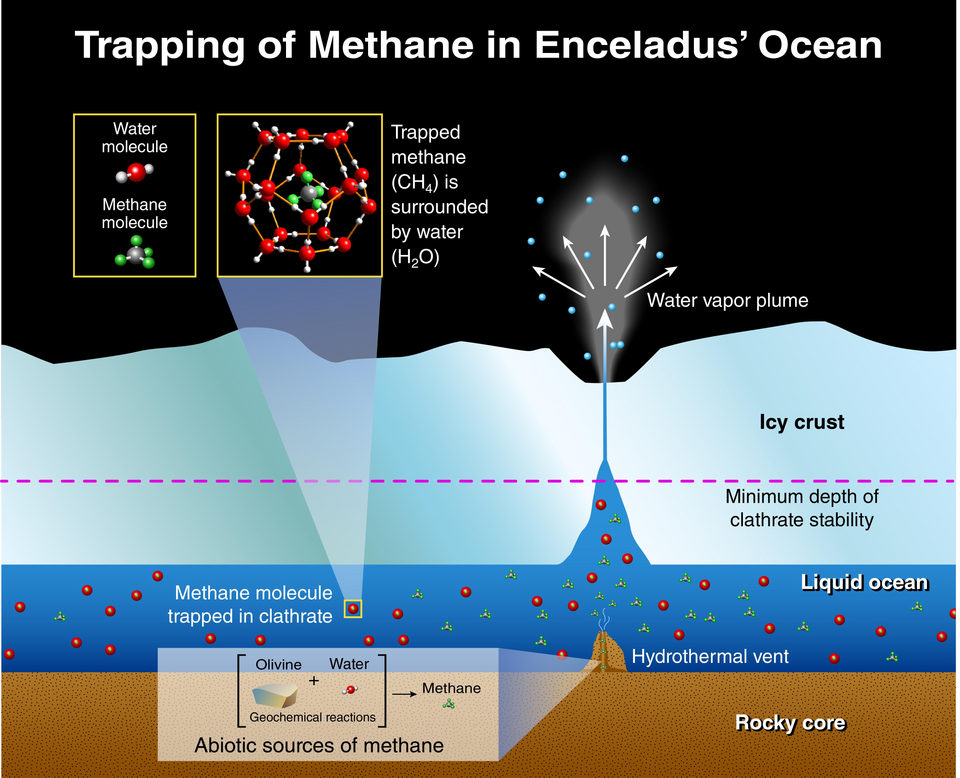
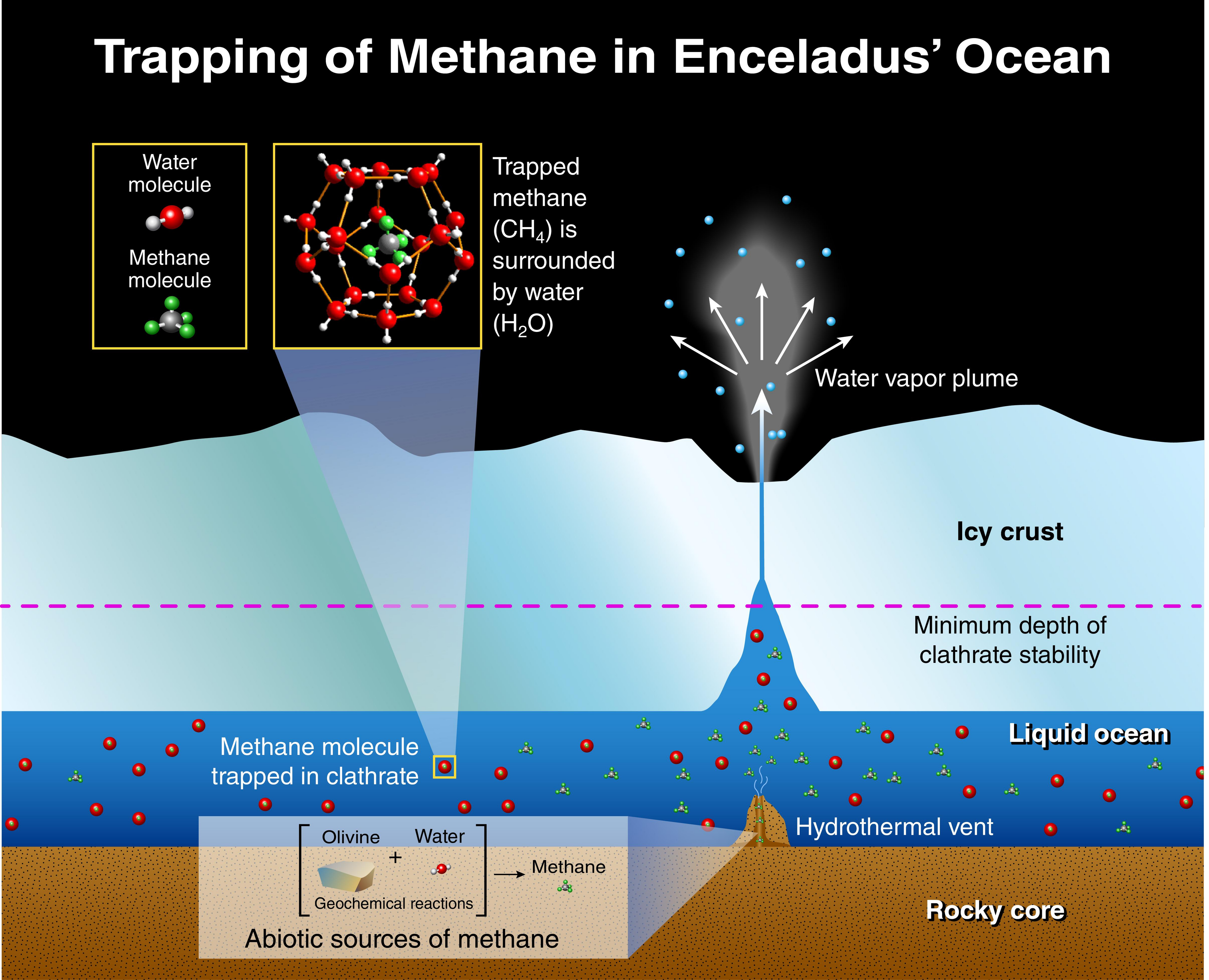
This illustration depicts potential origins of methane found in the plume of gas and ice particles that sprays from Saturn's moon, Enceladus, based on research by scientists working with the Ion and Neutral Mass Spectrometer on NASA's Cassini mission.

Scientists believe the plumes originate from an internal liquid-water ocean beneath the moon's south polar region. Recent findings from Cassini suggest hydrothermal activity as one of two likely sources of methane in the plume of gas and ice particles that erupts from the south polar region of Enceladus. The finding is the result of extensive modeling to address why methane, as previously sampled by Cassini, is curiously abundant in the plume.

Researchers with Cassini's Ion and Neutral Mass Spectrometer (INMS) determined that, at the high pressures expected in the moon's ocean, icy materials called clathrates could form that imprison methane molecules within a crystal structure of water ice. Their models indicated that this process could be so efficient at depleting methane from Enceladus' ocean that they still needed an explanation for the methane abundance in the plume.

In one scenario, hydrothermal processes supersaturate the ocean with methane. This could occur if methane is produced faster than it is converted into clathrates. A second possibility is that methane clathrates from the ocean are dragged along into the erupting plumes and release their methane as they rise, like bubbles forming in a popped bottle of champagne.

The authors agree that both scenarios are likely occurring to some degree, but they note that the presence of nanosilica grains, as documented by Cassini's Cosmic Dust Analyzer (CDA) instrument, favors the hydrothermal scenario.

The Cassini-Huygens mission is a cooperative project of NASA, the European Space Agency and the Italian Space Agency. NASA's Jet Propulsion Laboratory, a division of the California Institute of Technology in Pasadena, manages the mission for NASA's Science Mission Directorate, Washington. The Cassini CDA instrument was provided by the German Aerospace Center; the instrument team, led by Ralf Srama, is based at the University of Stuttgart in Germany. The INMS team is based at Southwest Research Institute, San Antonio, Texas.

For more information about the Cassini-Huygens mission visit http://saturn.jpl.nasa.gov and http://www.nasa.gov/cassini.
Sanasi
Manba http://photojournal.jpl.nasa.gov/jpeg/PIA19059.jpg
Muallif NASA/JPL-Caltech/SwRI
Other versions
File:Enceladus Methan im Ozean.svg is a vector version of this file. It should be used in place of this PNG file when not inferior.

File:PIA19059-SaturnMoon-Enceladus-OceanMethane-20150311.png → File:Enceladus Methan im Ozean.svg

For more information, see Help:SVG.

In other languages
Alemannisch ∙ العربية ∙ беларуская (тарашкевіца) ∙ български ∙ বাংলা ∙ català ∙ нохчийн ∙ čeština ∙ dansk ∙ Deutsch ∙ Ελληνικά ∙ English ∙ British English ∙ Esperanto ∙ español ∙ eesti ∙ euskara ∙ فارسی ∙ suomi ∙ français ∙ Frysk ∙ galego ∙ Alemannisch ∙ עברית ∙ हिन्दी ∙ hrvatski ∙ magyar ∙ հայերեն ∙ Bahasa Indonesia ∙ Ido ∙ italiano ∙ 日本語 ∙ ქართული ∙ 한국어 ∙ lietuvių ∙ македонски ∙ മലയാളം ∙ Bahasa Melayu ∙ မြန်မာဘာသာ ∙ norsk bokmål ∙ Plattdüütsch ∙ Nederlands ∙ norsk nynorsk ∙ norsk ∙ occitan ∙ polski ∙ prūsiskan ∙ português ∙ português do Brasil ∙ română ∙ русский ∙ sicilianu ∙ Scots ∙ slovenčina ∙ slovenščina ∙ српски / srpski ∙ svenska ∙ தமிழ் ∙ ไทย ∙ Türkçe ∙ татарча / tatarça ∙ українська ∙ vèneto ∙ Tiếng Việt ∙ 中文 ∙ 中文(中国大陆) ∙ 中文(简体) ∙ 中文(繁體) ∙ 中文(马来西亚) ∙ 中文(新加坡) ∙ 中文(臺灣) ∙ +/−
New SVG image

Litsenziyalash


This media was created by the Jet Propulsion Laboratory (JPL) at Caltech.
Their website states: "Unless otherwise noted, images and video on JPL public web sites (public sites ending with a jpl.nasa.gov address) may be used for any purpose without prior permission, subject to the special cases noted below. Publishers who wish to have authorization may print this page and retain it for their records; JPL does not issue image permissions on an image by image basis."
Conditions:

By electing to download the material from this web site the user agrees:

  • That Caltech makes no representations or warranties with respect to ownership of copyrights in the images, and does not represent others who may claim to be authors or owners of copyright of any of the images, and makes no warranties as to the quality of the images. Caltech shall not be responsible for any loss or expenses resulting from the use of the images, and you release and hold Caltech harmless from all liability arising from such use.
  • To use a credit line in connection with images. Unless otherwise noted in the caption information for an image, the credit line should be "Courtesy NASA/JPL-Caltech."
  • That the endorsement of any product or service by Caltech, JPL or NASA must not be claimed or implied.

Special Cases:

  • Prior written approval must be obtained to use the NASA insignia logo (the blue "meatball" insignia), the NASA logotype (the red "worm" logo) and the NASA seal. These images may not be used by persons who are not NASA employees or on products (including Web pages) that are not NASA sponsored. In addition, no image may be used to explicitly or implicitly suggest endorsement by NASA, JPL or Caltech of commercial goods or services. Requests to use NASA logos may be directed to agency-brand@mail.nasa.gov.
  • Prior written approval must be obtained to use the JPL logo (stylized JPL letters in red or other colors). Requests to use the JPL logo may be directed to the Institutional Communications Office, email jpl-media@jpl.nasa.gov.
  • If an image includes an identifiable person, using the image for commercial purposes may infringe that person's right of privacy or publicity, and permission should be obtained from the person. NASA and JPL generally do not permit likenesses of current employees to appear on commercial products. For more information, consult the NASA and JPL points of contact listed above.
  • JPL/Caltech contractors and vendors who wish to use JPL images in advertising or public relation materials should direct requests to the Institutional Communications Office, email jpl-media@jpl.nasa.gov.
  • Some image and video materials on JPL public web sites are owned by organizations other than JPL or NASA. These owners have agreed to make their images and video available for journalistic, educational and personal uses, but restrictions are placed on commercial uses. To obtain permission for commercial use, contact the copyright owner listed in each image caption. Ownership of images and video by parties other than JPL and NASA is noted in the caption material with each image.

Usage on the English Wikipedia: On the English Wikipedia you can use the {{JPL Image}} template to display the copyright notice. (See Wikipedia:Using JPL images for details)

Captions

Add a one-line explanation of what this file represents

Items portrayed in this file

tasvirlangan obyekt

11 mart 2015

Fayl tarixi

Faylning biror paytdagi holatini koʻrish uchun tegishli sana/vaqtga bosingiz.

Sana/VaqtMiniaturaOʻlchamlariFoydalanuvchiIzoh
joriy17:55, 2015-yil 12-mart17:55, 2015-yil 12-mart dagi versiya uchun tasvir4 820 × 3 906 (7,6 MB)wikimediacommons>DrbogdanUser created page with UploadWizard

Bu faylga quyidagi sahifa bogʻlangan: