
Fayl:KBOs and resonances.png


Qisqa izoh
| Warning | The original file is very high-resolution. It might not load properly or could cause your browser to freeze when opened at full size. |
|---|
| Taʼrif |
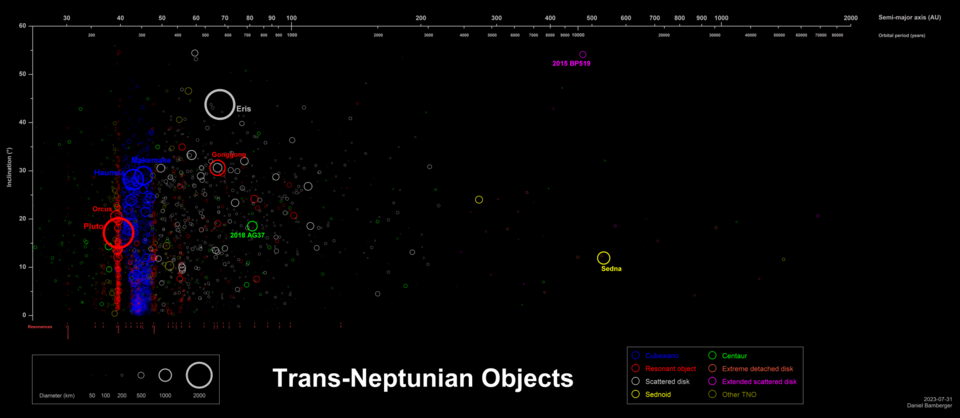
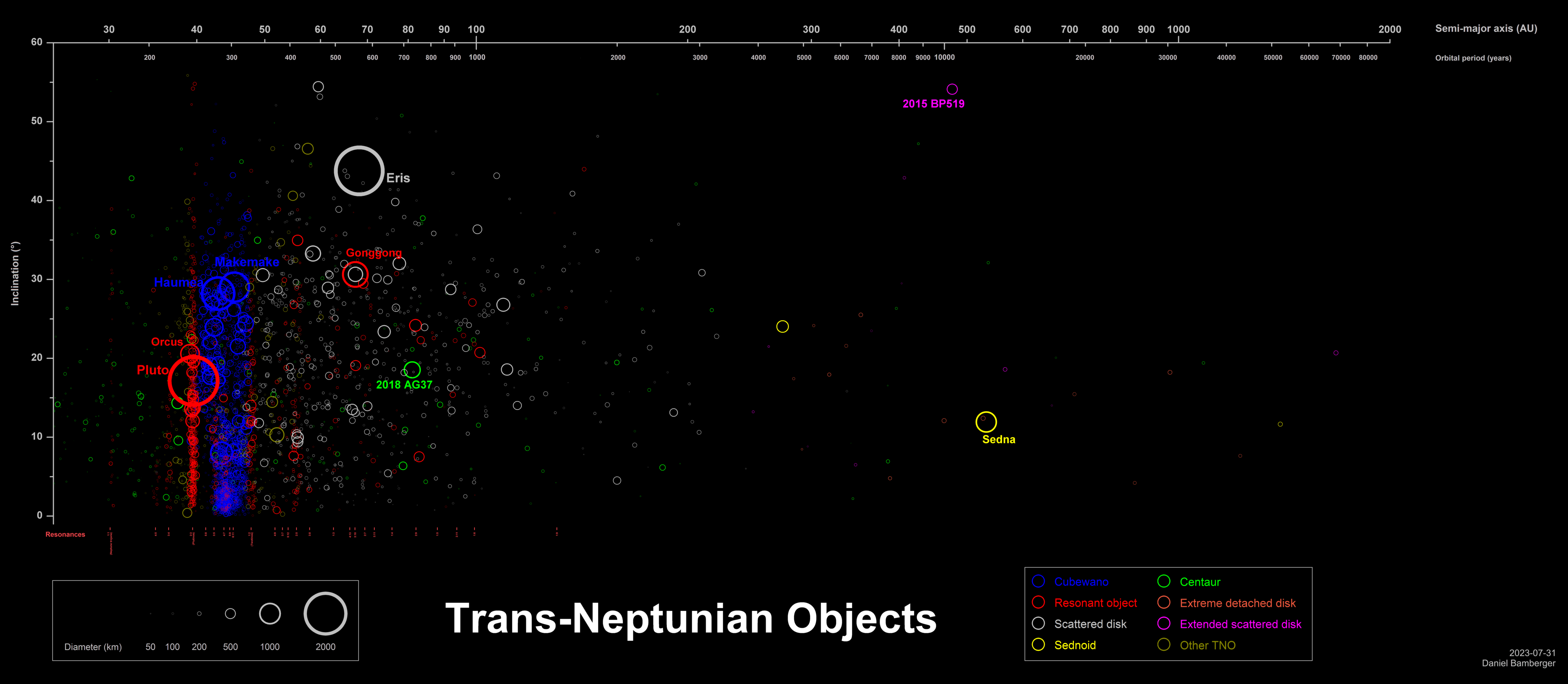
English: Distribution of Kuiper belt objects' orbits.
Objects in resonance are plotted in red (Neptune trojans 1:1, plutinos 2:3, twotinos 1:2,…). Classical objects are plotted in blue. Scattered disk objects (not members of the Kuiper Belt) are shown in grey, Sednoids in yellow, extreme detached disk objects in orange, extended scattered disk objects in magenta, centaurs in green, and other trans-Neptunian objects in dark yellow. Generated by Renerpho. Main graphThe position of an object represents
The size of the circle illustrates the object’s size relative to others. For a few large objects, the diameter drawn represents actual measurements. For all others, the circles represent the diameter corresponding to the absolute magnitude and an assumed albedo, based on the object's classification (see Johnston's page for details). Main resonances with Neptune are marked with vertical red bars; 1:1 marks the position of Neptune’s orbit (and its Trojan asteroids), 2:3 marks the orbit of Pluto (and the other Plutinos) etc. Data source |
| Sanasi | |
| Manba | Oʻzimning ishim |
| Muallif | Renerpho |
| Other versions |
File:KBO_diagram_eccentricity.png Alternative version by User:Thunkii: File:TNOs-wide-view.svg |


Litsenziyalash


- Siz erkinsiz:
- ulashishga – ishlanmani nusxalash, tarqatish va uzatish
- remiks qilishga – ishni moslashtirishga
- Quyidagi shartlar asosida:
- atribut – Siz tegishli litsenziyaga havolani taqdim etishingiz va oʻzgartirishlar kiritilganligini koʻrsatishingiz kerak. Siz buni har qanday oqilona yoʻl bilan qilishingiz mumkin, lekin litsenziar Sizni yoki Sizning foydalanishingizni ma'qullashini taklif qiladigan tarzda emas.
- bir xil ulashish – Agar Siz materialni remiks qilsangiz, oʻzgartirsangiz yoki unga asoslansangiz, oʻz hissalaringizni asl nusxadagi kabi bir xil yoki mos litsenziya ostida tarqatishingiz kerak.
Fayl tarixi
Faylning biror paytdagi holatini koʻrish uchun tegishli sana/vaqtga bosingiz.
| Sana/Vaqt | Miniatura | Oʻlchamlari | Foydalanuvchi | Izoh | |
|---|---|---|---|---|---|
| joriy | 14:35, 2023-yil 31-iyul | Miniatyurasi yoʻq | 13 860 × 6 044 (920 KB) | wikimediacommons>Renerpho | New selection of highlighted objects; repair horizontal scale |
Fayllarga ishoratlar
Bu faylga quyidagi sahifa bogʻlangan:
