
Fayl:Kösem portrait (cropped).jpg

Qisqa izoh
| Taʼrif |
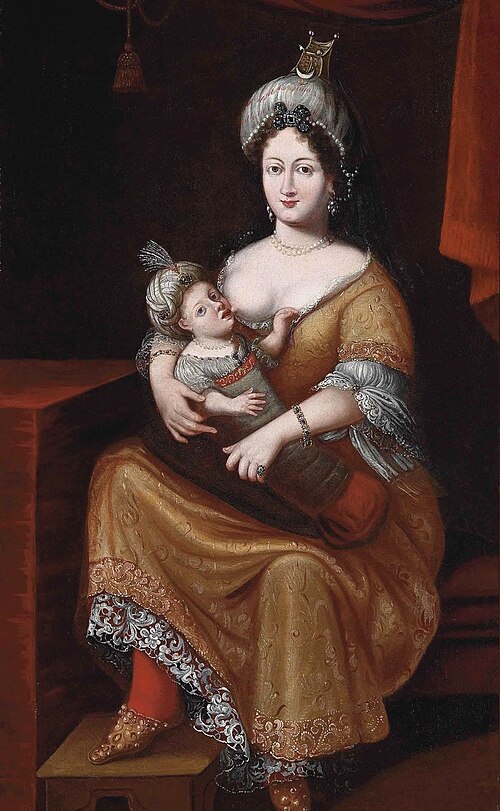
English: Oil on canvas, depicting the favourite consort of Sultan Ahmed I (r.1603-1617), known as Kösem or Mahpeyker Sultan, breastfeeding her son, either the future Sultan Murad IV (r.1623-1640) or Sultan Ibrahim (1640-1648), both figures wear extensive hardstone-studded jewellery and large rounded cloth turbans, Kösem Sultan also wears golden brocade garments, fine white lace and jewel-studded pointed shoes, above the pair hangs a European-style red velvet curtain. The headdress seen here, with its high back supporting a veil, relates closely to a number of other examples depicted in Europe worn by ladies who are clearly identified as Ottoman rulers' wives. The scene could only have taken place within a year of his birth in 1612, and thus some fifteen years before the Kuefstein embassy.
The style of the painting shows clear French influence, especially in the modelling and in the high forehead typical particularly of Pierre Mignard, a Paris society portrait painter (Lada Nokolenko, Pierre Mignard, the Portrait Painter of the Grand Sicle, Munich, 1982, esp. pl.15). It shows it to be the work of a different artist from the Kuefstein depiction, but the format and size are directly comparable to the Kuefstein paintings. It also has an Italian provenance, which was also the case for a group of paintings thought to be from Kuefstein which appeared at auction at Sotheby's in London (Old Master Pictures, 27 May 1987, lots 86-92). It appears thus to be a missing Kuefstein painting depicting the most powerful woman of the Ottoman Empire. An original painting dating from circa 1630 closely related to and almost certainly the source of this print, is in a private collection (illustrated left). Apart from the whole depiction being reversed, the relationship between the page and the main figure is identical, as are the costumes of the two figures. The painting is one of a series that were painted for Hans Ludwig Graf von Kuefstein, either during or more probably immediately after his embassy to the Ottoman Court in Istanbul in 1628. On that embassy he was accompanied by two artists, almost certainly Franz Herrmann and Hans Gemminger, possibly assisted by Herrmann's apprentice, Valentin Mueller (Philip Mansel, 'Between Two Empires: Hans Ludwig von Kuefstein, Ambassador from the Holy Roman Emperor to the Ottoman Sultan in 1628, and his pictures', At the Sublime Porte, Ambassadors to the Ottoman Empire (1550-1800), exhibition catalogue, Hazlitt, Gooden & Fox, London, 1988, p.18). It is impossible that the depictions of Turkish ladies were painted from life, however much they may have been declared to be "true likenesses" (Eleanor Sims, 'Hans Ludwig von Kuefstein's Turkish Figures, in At the Sublime Porte, op.cit., p.26). While the Kuefstein painting does not bear a rubric in German on the face, it has always been identified as Kösem Sultan, the mother of Sultan Ibrahim, and the print leaves no doubt as to this being the identity of the sitter. The face of Kösem Sultan in the Kuefstein painting is in turn strikingly similar to that of our subject. Both are wearing identical turbans and superstructures on top of them. It is clear from the comparison with the Kuefstein painting that ours is also intended to depict Kösem Sultan. ([1] |
| Sanasi | Second quarter 17th century |
| Manba | CIRCLE OF FRANZ HERRMANN AND HANS GEMMINGER, AUSTRIAN SCHOOL, SECOND QUARTER 17TH CENTURY |
| Muallif | Anonymous |
Litsenziyalash
|
This is a faithful photographic reproduction of a two-dimensional, public domain work of art. The work of art itself is in the public domain for the following reason:
The official position taken by the Wikimedia Foundation is that "faithful reproductions of two-dimensional public domain works of art are public domain". This photographic reproduction is therefore also considered to be in the public domain in the United States. In other jurisdictions, re-use of this content may be restricted; see Reuse of PD-Art photographs for details. {{PD-Art}} template without license parameter: please specify why the underlying work is public domain in both the source country and the United States
(Usage: {{PD-Art|1=|deathyear=''year of author's death''|country=''source country''}}, where parameter 1= can be PD-old-auto, PD-old-auto-expired, PD-old-auto-1996, PD-old-100 or similar. See Commons:Multi-license copyright tags for more information.) | ||||



Fayl tarixi
Faylning biror paytdagi holatini koʻrish uchun tegishli sana/vaqtga bosingiz.
| Sana/Vaqt | Miniatura | Oʻlchamlari | Foydalanuvchi | Izoh | |
|---|---|---|---|---|---|
| joriy | 17:14, 2021-yil 14-noyabr | | 994 × 1 613 (497 KB) | wikimediacommons>Jacob Historian | Uploaded a work by Anonymous from Ottoman archives with UploadWizard |
Fayllarga ishoratlar
Bu faylga quyidagi sahifa bogʻlangan:
